 Treatments
Botox vs. Fillers
One softens motion, the other rebuilds structure. Here is how to tell which one fixes what you're seeing.
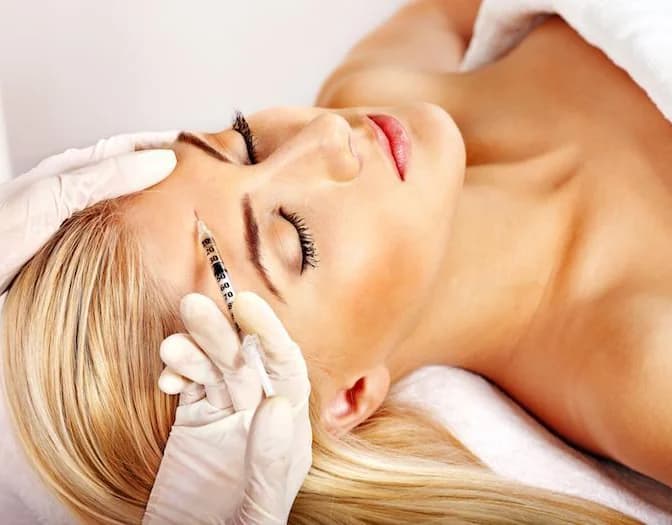
Not sure
which?
Two different
jobs
Botox, a neuromodulator, relaxes the muscles that crease skin into lines that come from movement. Filler restores volume and structure where the face has lost it. Lines that deepen when you frown, squint or raise your brows point to Botox; hollows, folds and flattening point to filler. Many plans use both, in different areas.
Lines from movement are the forehead creases, the “11s” between your brows and the crow’s feet at the corners of your eyes. A muscle pulls the skin into that shape every time you make the expression. Quiet the muscle with Botox and the crease it carves softens.
Lines and hollows from volume loss work differently. Cheeks flatten, lips thin, and the folds from nose to mouth (nasolabial folds) and mouth to chin (marionette lines) deepen as support underneath fades. No muscle is causing those, so relaxing one changes little. Dermal fillers put the structure back.
A quick test in the mirror: make the expression, then relax. A line that appears with the expression and disappears at rest is a movement line. One that stays put, or a shadow that looks like a hollow, usually involves volume.
One softens motion, the other rebuilds structure. Our board-certified nurse practitioners decide which your face needs, and often it is a little of each.
Forehead lines, the 11s and crow's feet. Results build over about two weeks and typically hold three to four months.
Cheeks, lips, folds and jawline. The change is visible immediately and lasts six to eighteen months or more, depending on product and area.
Many faces show both kinds of change. The two treatments work in different places and frequently share an appointment.
You don't need to arrive knowing. Your provider assesses whether the concern is movement, volume or skin quality before suggesting anything.
Botox and fillers, side by side
Figures are typical ranges; your own depend on the product, the area and how your body processes it.
| Botox | Dermal fillers | |
|---|---|---|
| What it is | A purified neuromodulator. Jeuveau and Xeomin belong to the same family. | A smooth injectable gel, most often hyaluronic acid, or a collagen stimulator such as Radiesse or Sculptra. |
| What it does | Relaxes the small muscles that fold skin into expression lines. | Restores volume and structure where the face has lost it. |
| Best for | Forehead lines, the 11s between the brows, crow's feet. | Flattened cheeks, thinning lips, nasolabial folds, marionette lines, jawline and chin definition. |
| When you see it | Movement softens within 3 to 7 days; the full effect shows at about 2 weeks. | Immediately. You leave the appointment seeing the change. |
| How long it lasts | Typically 3 to 4 months. A first-ever treatment can fade in 2 to 3. | Lips typically 6 to 12 months; cheeks and jawline 12 to 18 months or more. |
| Can it be reversed? | No, but it wears off as the nerve signal returns. | Hyaluronic-acid fillers can be dissolved with hyaluronidase. Radiesse and Bellafill cannot. |
| Aftercare | Stay upright for 4 hours, don't rub the area, skip heavy exercise, facials and massages for 24 hours. | Stay upright for 4 hours and skip heavy exercise for 24 hours. Swelling for a day or two is normal. |
For a closer look at how long each neuromodulator holds by area, read how long Botox lasts.
Start with what you’re seeing, not the product name.
These are the usual starting points, not a diagnosis. Under-eye hollows in particular are the most technical area on the face; some candidates are better served by a skin-quality treatment such as Salmon DNA than by filler, and that is a call made in person.
Forehead Lines, 11s, Crow's Feet
Expression lines from a muscle pulling. This is neuromodulator territory: Botox, Jeuveau or Xeomin.
Flat Cheeks, Thin Lips, Deep Folds
Flattened cheeks, thinning lips, nasolabial folds and marionette lines come from lost volume. Filler rebuilds it.
Lines at Rest That Deepen with Expression
A crease you can see when relaxed that sharpens when you move often has both causes, and often needs both treatments.
Hollows Under the Eyes
A filler or Salmon DNA conversation, depending on how thin the skin is. Botox does not treat hollows.
When you need both
Many faces show some of each: a little movement etching in around the eyes and brow, a little volume leaving the cheeks and lips. Treating only one of them tends to leave the result looking half-finished, which is why many plans pair a neuromodulator in the upper face with filler in the mid and lower face.
Neuromodulators and fillers frequently share an appointment. Some combinations are better sequenced across visits, so each treatment settles before the next is judged. Your provider sets the order at the consultation, and plans are built gradually: adding later is easy, and subtlety is the point.
For more on how the whole category fits together, from neuromodulators to regenerative injections, see our injectables overview.
Other neuromodulators and fillers we carry
“Botox” is often used for the whole category. Skin Med Spa also offers Jeuveau and Xeomin, neuromodulators that work the same way. How they differ is covered in Botox vs. Jeuveau vs. Xeomin.
On the filler side, the lineup runs from hyaluronic-acid gels (Juvéderm, Restylane, Revanesse Versa, Evolysse and Obagi MagIQ) to collagen stimulators such as Sculptra, Radiesse and hyperdilute Radiesse, plus Bellafill for longer-term correction. Which gel suits which area is the subject of which filler is best for lips, cheeks and under eyes, and for under-eye skin quality there is Salmon DNA.
Movement or
volume?
Usually the
first question.
No. Botox is a neuromodulator: it relaxes the muscle that creases the skin, and it adds no volume. Filler is a gel placed under the skin to restore volume and structure. They are often mentioned together because both are injected, but they do different jobs.
Filler, in most areas. Botox typically holds three to four months, and a first-ever treatment can fade a little sooner. Lip filler typically holds six months to a year, while cheek and jawline products can last twelve to eighteen months or more.
Often yes. Neuromodulators and fillers frequently share an appointment, while some combinations are better sequenced across visits. Your provider sets the order at the consultation so each treatment settles properly.
The 11s are expression lines made by the frown muscles, so they are a neuromodulator area: Botox, Jeuveau or Xeomin. Your provider looks at how the line behaves at rest and in motion before recommending a plan.
Filler. Nasolabial folds and marionette lines come mostly from lost volume and support, not from a muscle pulling, so Botox does little for them. Well-placed filler, sometimes in the cheek above the fold, is the usual approach, and Bellafill is an option for longer-term correction of smile lines.
Botox cannot be reversed, but it wears off as the nerve signal returns over about three to four months. Hyaluronic-acid fillers can be dissolved with an enzyme called hyaluronidase. Radiesse and Bellafill cannot be dissolved this way, which is one reason the product choice is made carefully.
Where to next?
Related treatment
Botox®
The gold-standard neuromodulator for forehead lines, the 11s, and crow's feet.
Explore the treatmentRelated treatment
Dermal Fillers
Premium fillers restoring volume to lips, cheeks, jawlines, and deep folds.
Explore the treatmentCommon question
Botox, Jeuveau, or Xeomin: which should you choose?
All three are botulinum toxin type A for frown lines and last 3 to 4 months. The real differences: proteins, labeled uses, price, and rewards programs.
Read the answer
Not sure which?
That’s what the consultation is for.
Medically reviewed by Barbara Kowalczyk, FNP‑BC and Michael Fressola, ACNP‑BC, board-certified nurse practitioners at Skin Med Spa. This page is for education and is not a substitute for a personalized medical consultation.