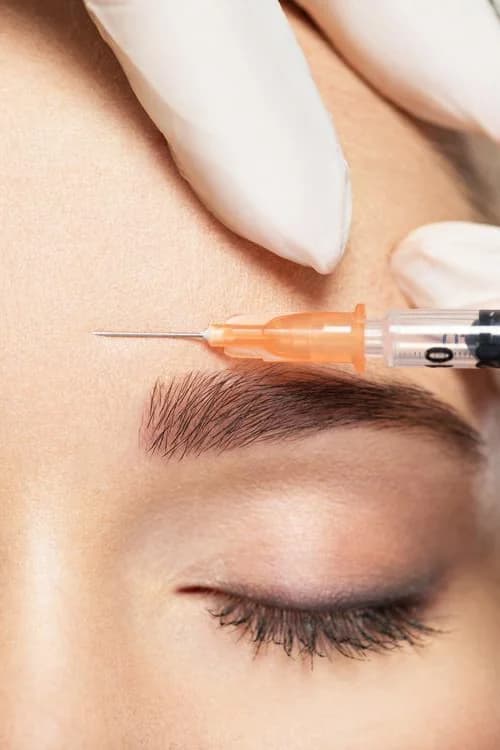
The gold standard for motion lines on foreheads, the 11s, and crow's feet, with decades of safety data behind it.
Botox®
Wrinkles come in two kinds, and telling them apart is the whole game. Motion lines appear when you frown, squint, or raise your brows, then fade when your face relaxes. Etched lines are the ones that stay put even when your face is still, carved in by years of repetition and collagen loss.
The distinction matters because the treatments split the same way: neuromodulators quiet the muscles behind motion lines, while resurfacing and collagen-building treatments repair lines that have settled into the skin itself. Many patients need a little of both, which is exactly what a consultation sorts out.
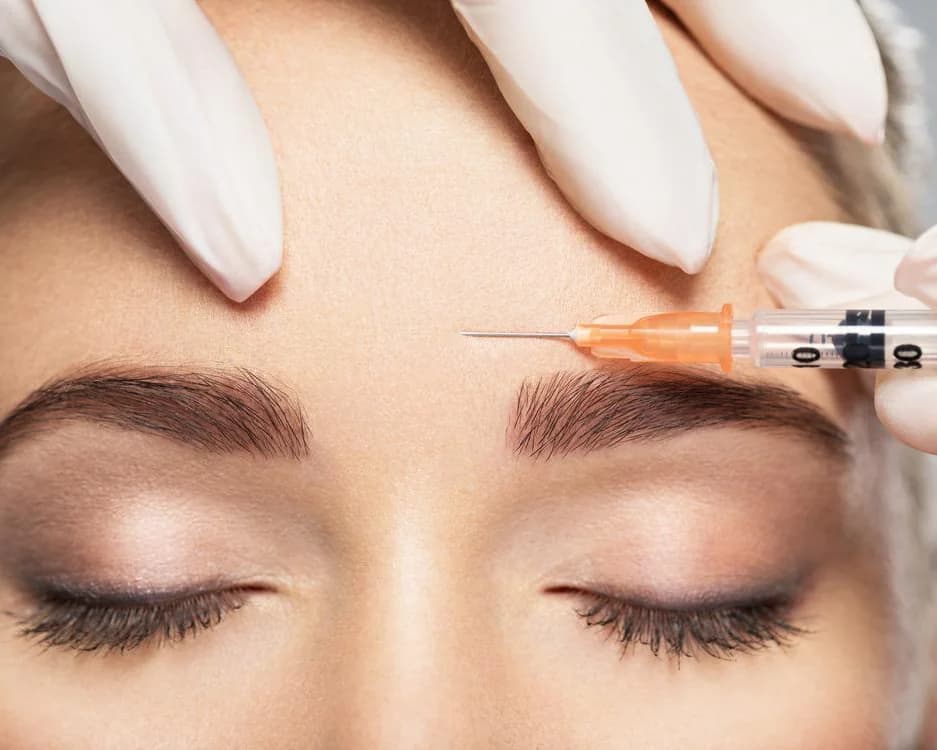

Every wrinkle treatment here works on one of two layers. Neuromodulators — Botox, Jeuveau, and Xeomin — work on the muscle. A few precise injections quiet the repetitive contractions that fold the skin in the first place, so the forehead lines, the 11s, and crow’s feet stop being creased dozens of times an hour. The skin above the muscle finally gets to rest, and motion lines soften or disappear.
Etched lines need the second layer: the skin itself. CoolPeel’s CO2 energy resurfaces the top layers so smoother skin replaces the creased surface, while VirtueRF drives radiofrequency heat deeper through microneedles, prompting the skin to rebuild the collagen scaffolding that thinned out under the line. Both are controlled damage that your skin answers with repair.
Salmon DNA sits in a third, gentler family — regenerative boosters injected where fine lines are just beginning. Rather than relaxing anything or resurfacing anything, they thicken and rehydrate the skin from within, which makes early lines less visible and gives the other treatments better material to work with.

The neuromodulators are the low-commitment end of the spectrum: no downtime, results within days, and a face that moves naturally when dosed well. The tradeoff is maintenance — the effect fades over a few months, so smoothness becomes a standing appointment rather than a one-time fix. Between Botox, Jeuveau, and Xeomin, the differences are onset speed, formulation purity, and price, which is a preference conversation, not a quality ranking.
The collagen-building treatments run the opposite direction. CoolPeel asks for days of social downtime and VirtueRF for a series of sessions, but they change the skin itself, and that repair holds far longer than any injectable wears off. Salmon DNA splits the difference — a short series, minimal disruption, gradual payoff.
Most patients over thirty-five have both kinds of lines, which is why the combination — a neuromodulator for motion, a resurfacing or collagen treatment for what’s already etched — outperforms either alone. The consultation is where a provider reads your lines at rest and in motion, then matches the plan to your downtime tolerance and your calendar.
Listed in the order we most often recommend them. Your consultation decides which actually fits your skin, goals, and downtime.
The gold standard for motion lines on foreheads, the 11s, and crow's feet, with decades of safety data behind it.
Botox®
A modern, aesthetics-only alternative that works like Botox, often with faster onset and friendlier pricing.
Jeuveau®
The uniquely purified “naked” neuromodulator — the switch to consider when results have stopped lasting.
Xeomin®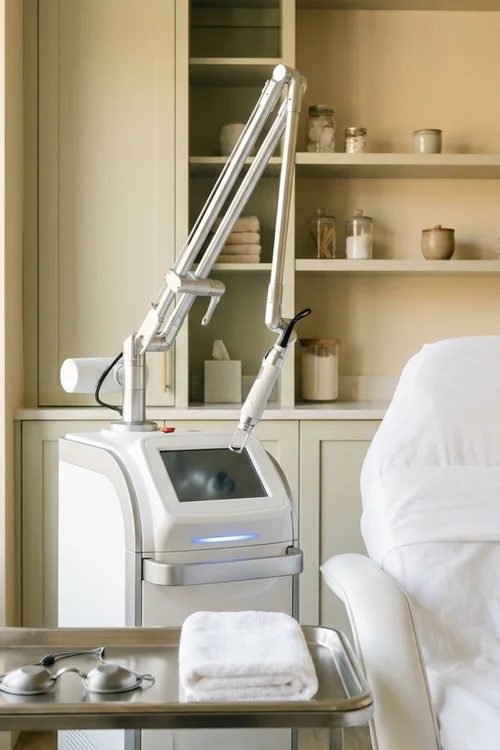
CO2-grade resurfacing that smooths etched-in lines with only days of downtime.
CoolPeel® CO2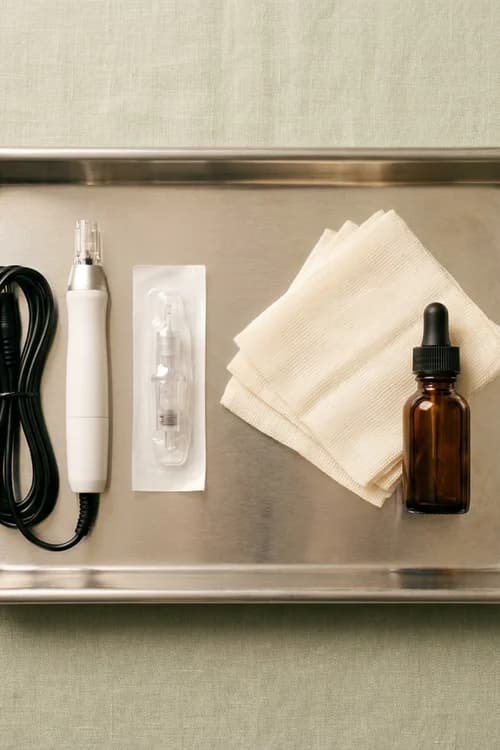
RF microneedling that rebuilds collagen deep beneath fine lines while tightening the surface.
VirtueRF Microneedling
Regenerative boosters that thicken and rehydrate skin where fine lines are just beginning.
Salmon DNACommon question
Most people get 3 to 4 months from a Botox treatment. Your first round often fades a little faster, and the area treated changes the number more than…
Read the answerCommon question
CoolPeel typically has 1 to 3 days of downtime. Expect sunburn-like redness for a day or two and skin that feels rough for a few days, far less than…
Read the answerRelated concern
Restore volume, shape, and balance
Explore the concernNot sure which is right? That's what consultations are for.
Prefer to talk? Call 630-541-8413 — same-day appointments available.
Medically reviewed by Barbara Kowalczyk, FNP‑BC and Michael Fressola, ACNP‑BC, board-certified nurse practitioners at Skin Med Spa. This page is for education and is not a substitute for a personalized medical consultation.