 Treatments
IPL Photofacial
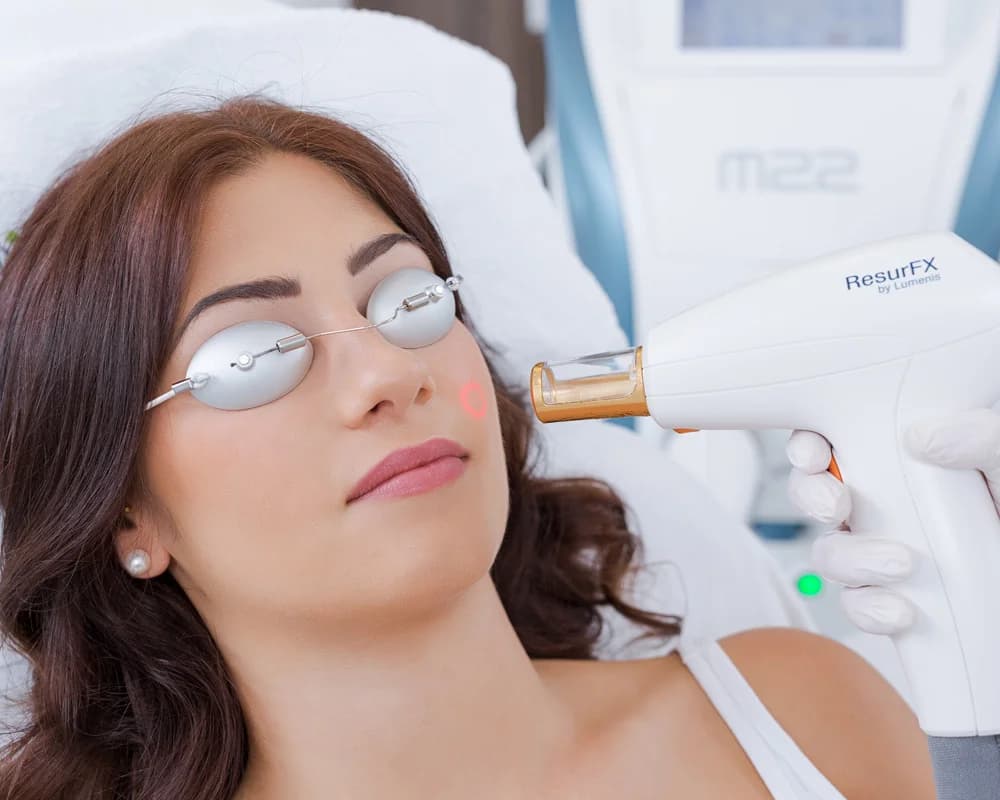
Broad-spectrum light on the Lumenis M22 clears sun spots, redness, and rosacea flushing, revealing the even tone underneath.
Curious about
IPL?
What is an
IPL photofacial?
IPL stands for intense pulsed light: calibrated flashes that pass harmlessly through the skin's surface and land selectively on what discolors it.
Brown pigment from sun exposure absorbs the light and breaks apart, surfacing and flaking away over the following week — most sun spots clear within a few sessions. Red vessels from rosacea, spider veins, and broken capillaries absorb it too, collapsing and fading.
The result is subtractive in the best way. Nothing is added to your skin; the discoloration simply leaves, and what remains is the even tone it was hiding.
On the M22, our specialists tune the light's filters to your exact mix of brown and red, which is the difference between a generic flash and a precise correction.
Sun spots, freckling, capillaries, and flushing all respond within the same treatment.
Light passes through intact skin. Expect mild warmth and temporary darkening of spots, nothing raw.
A full face takes about 30 minutes; chest and hands add minutes, not hours.
Pigment lifts within a week or two of each visit, with tone improving across the series.
When the mirror shows spots the sun left, light takes them back.
Pigment work rewards precision and patience. Your specialist maps whether the discoloration is brown, red, or both, then sets a series length you can plan around.
Sun Spots Multiply Yearly
Decades of Illinois summers surface as freckling and patches that concealer manages poorly.
Redness Reads as Permanent
Persistent flushing and visible capillaries respond to vessel-targeted light.
Rosacea Flares Rule the Week
Reducing the vascular background lowers both the baseline redness and flare frequency.
Tone, Not Texture, Is the Issue
If skin feels smooth but looks uneven, pigment is the problem and IPL is the tool.
The sun kept
a diary.
Light erases
the entries.
They briefly get darker. Treated pigment rises to the surface looking like coffee grounds over several days, then flakes away naturally. That darkening is the treatment working, not a side effect going wrong.
Most patients see meaningful clearing in three to five sessions spaced about a month apart. Long-standing sun damage and rosacea usually sit at the higher end, which your specialist will estimate honestly up front.
It is one of the most effective options available. IPL targets the dilated vessels that cause persistent flushing and visible capillaries, reducing both the background redness and the frequency of flares.
IPL reads pigment to find its targets. A tan confuses that reading and raises risk, so we ask for two to four weeks of diligent sun protection before and after every session.
Technically no. Lasers use a single wavelength; IPL fires a calibrated burst of many wavelengths at once, filtered to reach both brown pigment and red vessels in the same pass. That breadth is exactly what makes it ideal for mixed sun damage.
Where to next?
Related treatment
CoolPeel® CO2
CO2-grade resurfacing with only days of downtime on the Tetra platform.
Explore the treatmentThe concern it treats
Sun Spots & Uneven Tone
Clear sun damage and even out tone
Start from the concernCommon question
How many sessions to remove sunspots?
Many discrete brown sunspots clear in 1 to 3 IPL sessions. After treatment the spots often darken briefly, then flake away over 1 to 2 weeks. Deeper or…
Read the answer
One tone.
Evenly yours.
Medically reviewed by Barbara Kowalczyk, FNP‑BC and Michael Fressola, ACNP‑BC, board-certified nurse practitioners at Skin Med Spa. This page is for education and is not a substitute for a personalized medical consultation.